
| HOME | Current Position Report | Logs & Stories | Photos | People | The Boat | Contact Us |
|
| |||||||
| |||||||
 In this section... Logs Index Dec. 2002 Nov. 30 Nov. 29 Nov. 28 Nov. 27 |
Logs & Stories - November 2002November 30 - Still in Agua Verde(Email via Internet Cafe) Bill here. Another restful day. This morning three of the boats sharing our cove departed, leaving only two remaining. Quite a different feel; the town left. The big event of the day was when a 40-foot trawler motorboat came in and put his anchor very close to ours. When they set it, they managed to motor the boat backward in a direction different than that of the wind, which made their too-close anchoring not immediately obvious to them. Karryn and the kids thought we should say something right away. I decided to wait. I mean these guys are here. You don't get here without traveling through some serious water. The experience tends to hone your skills and get you in the habit of staying calm. Shortly, the wind swung the trawler around close enough to us that I could have hit their boat with a running start off of ours. I'm thinking 'hit' is the right word: not a good landing, but more likely a 'splat' against the side of their hull, followed by a 'splash' as my body plunged into the water. Too close. I had a brief, friendly conversation with the captain of the boat, we laughed at the situation, and I gave him some advice based on the location of the boats that had left earlier in the day. He re-anchored, then launched his dinghy and came over for a visit. It turned out that Don, the captain, and Joe, his only crew, had some leftover candy from Halloween and he wanted to give it to Jax and Naomi. Reese's peanut butter cups and Kit Kats, two of their favorite species of chocolate, along with a bag of cheddar Goldfish crackers, a treat we hadn't seen since leaving the U.S. Late in the day we went to the beach. As has become our habit, Jackson and I went for a walk along the shore, a gravel beach turning into a wide horizontal rock ledge just inches higher than water level, turning, still further on, into a landslide of giant boulders falling from an enormous rock cliff. Jackson and I adeptly dodged the huge stones; we were moving in biological time, they in geologic. ******************* I'm back in the port ama again. This time I've gotten a little more serious about this thinking thing: I've started rearranging 'furniture' for my comfort. Sail bags moved and placed just so, fenders neatly stacked at one end to make a backrest. Here we go again… So, I'm pondering the pending food crisis the Baja fishermen are going to have, and it occurs to me that it's even worse. Most of the small villages along the peninsula have tiendas, small stores within their proprietor's homes, and these tiendas are stocked with an amazing variety of food, much of it fresh fruit and vegetables. They have a huge impact on the villagers' diet. This stuff obviously comes from someplace else, probably by panga or car, both using petroleum fuel. With oil gone, that food won't be there. |
| There had been a plan for a beach potluck at 2:30 p.m., but the rain clearly spoiled it. Ross and Joy on Spirit of Joy immediately volunteered to host the potluck on their boat, a terrific turn of events - the name of their boat fit the occasion wonderfully. We had a lovely time, making new friends, meeting old ones again. We stayed until well after dark and then returned to Seafire. | 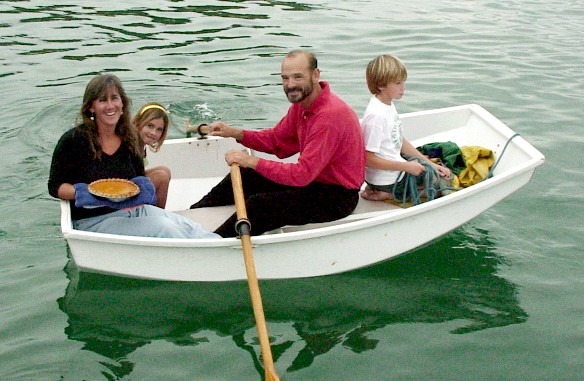 |
| About bedtime, another squall moved in. We could hear it coming. The night was pitch black; the cloud's sound was thunderous. What made it so loud - dangerously high winds or simply falling water? The sound became progressively more deafening. All four of us quickly went into motion: we scrambled to take down our cockpit awning before it could be damaged by high winds. As we swiftly untied lines and opened snaps, we could hear the black wall approaching - a hundred yards away, two hundred feet, a hundred feet, fifty feet. How bad would it be? Immediately before it hit, I just managed to toss the wadded awning into an ama and close the hatch. As the squall engulfed us, I felt a sense of relief. It wasn't wind, only water. And it only lasted a few minutes. How anticlimactic. We laughed at ourselves. | 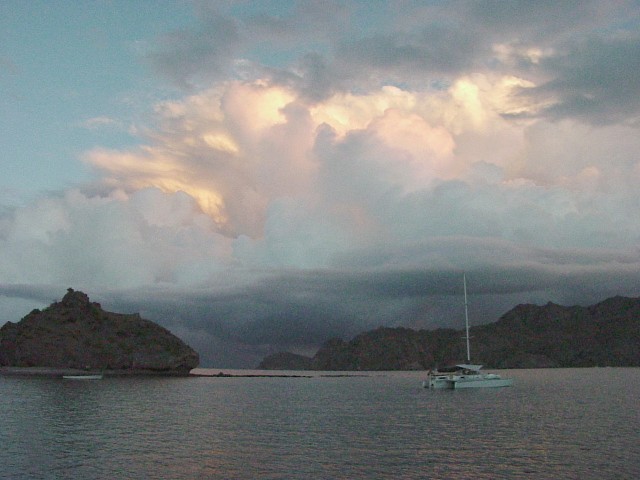 |
*******************
So, back to me sharing my thoughts. Or 'back to my wandering mind.' Or perhaps, 'back to my wondering mind.'
Back when I was fully over-employed, I had no time for thinking. I'm kinda getting into it now, though. I find it's best when I'm undisturbed.
"But you live on a sailboat with three other people!" you say. "How do you get any quiet space to yourself?" I have a technique. I live on a sailboat, but not just any sailboat. A Searunner trimaran. A center-cockpit sailboat with training wheels. There are four places to be: aft cabin (largest space with two dinettes), forward cabin, port ama (outer hull) and starboard ama. If the weather is good (good by Seattle standards: not raining), I'll open the hatch to one of the amas and crawl inside. Since it's often bright outside, I usually wear a faded baseball hat and sunglasses. I imagine that I look like some combination of Snoopy climbing into his Sopworth Camel and Duke from Doonesbury ducking for cover down a manhole.
So, sometime after I read "Ishmael", Jackson mentioned that his Encyclopedia of Science said we were going to run out of oil. He asked if this was true. I did the fatherly thing, and launched into a lecture about limited natural resources, using the example of fishing and logging in our native Pacific Northwest, saying, yes, we've known for quite some time the petroleum supply would sometime run out, perhaps in forty or fifty years. Later, when I was in the port ama having great thoughts, or at least having thoughts, the solution to Daniel Quinn's environmental destruction problem occurred to me: we're going run out of oil. Think about it: nearly all the damage done to other forms of life is executed by oil-driven machinery - trawlers, fish processors, logging trucks, chainsaws, excavators, bulldozers, combines, crop dusters… everything! Oil is magic: compact, mobile energy you can carry around in a plastic jug. In spite of the fact that it's been 30 years since the 'Energy Crisis', no competing technology of scale has emerged.
The world will survive: once the oil is gone, chainsaws, trawlers and crop dusters will lie still.

(Email via Internet Cafe)
Bill here.
In case you can't read Spanish, we're going from Hidden Harbor to Green Water.
As I write this, we're motoring southward in a calm. Karryn and Jackson are in the cockpit, Naomi asleep on the forward dinette. The scenery outside is spectacular - high, angular, stratified cliffs rising from the placid water, jagged peaks and mountains as far as you can see. We just passed a tiny island with a huge reef immediately south of it.
We'd originally planned on spending just a single night in Puerto Escondido, but ended up staying ten days. It's a unique place. The nearest town is Loreto, which is about 150 miles north of La Paz (a five hour drive, I'm told), and home of the only jet airport in Baja outside La Paz and Cabo San Lucas.
The immediate area is stunningly beautiful. West of the anchorage, across a plain of cactus and desert scrub, there lies the most impressive section of the appropriately named Sierra Gigante mountains, rising vertically to nearly 5000 feet only a few kilometers from the coast. The mountains are awe-inspiring, a slab of Pacific Plate tilted upward, a ragged line against the cloudless blue sky, stratified cliffs of red and brown, deep canyons carved by millions of years of hurricanes dumping themselves onto rock faces, water shedding down vertical slopes.
Puerto Escondido is arguably the best hurricane hole in Baja. It is a large bay, perhaps a mile long and half a mile wide, and, with the exception of the narrow, shallow entrance (10' deep), it is completely landlocked, feeling more like a mountain lake than a saltwater harbor. The northern end is made up of a high point and two tall islands that may have long ago had channels between them but now are bridged with low rock spits. The configuration lets little wind and no waves enter. Except for hurricanes, the strongest winds here are the winter northerlies, which can blow 30 knots for days and generate large, steep wind waves; Escondido blocks these completely. While not quite as protected an anchorage as Puerto Don Juan up in Bahia de Los Angeles, the access to the airport and Highway 1 make it possible to secure a boat and make a hasty exit in the event of an approaching hurricane.
There are virtually no facilities, only a small store at the Tripui RV Park a mile's walk away and fresh water available near the harbor's entrance. There is no marina, and boats are able to anchor here for only the small entry fee charged by the Port Captain in nearby Loreto.
Escondido's unique combination of all-weather protection, low cost, and transportation access make it an ideal place for Americans to keep their boats. The harbor is full of yachts, most of them empty. On our first visit we reacted in horror: a boat graveyard.
It is interesting to me that we changed our minds about Puerto Escondido, now seeing a restful place of beauty where a community of Mexicans and Americans live in relaxed calm. Strangers like us are constantly treated to random acts of kindness; it seemed that every time we walked to the store, some local offered to give us a ride. On our last night there, we went for a hike too late in the day and were faced with a walk back to Seafire on a moonless night without the aid of a flashlight. Unexpectedly, a gentleman named Chris picked us up, and not only drove us to the end of the road, but also escorted us, flashlight in hand, to the dinghy landing, then invited us over to his house the next day. We took advantage of his offer, and enjoyed a pleasant morning with him and his wife, Pam.
*******************
We're approaching Agua Verde now, so I have to close this up shortly. I still have quite a bit to write - it's been over two months since I sent anything (Karryn did the single web entry in October), and we have a lot to tell you about. I'll try to make room to continue tomorrow.
I do want to talk about one other thing, though. My life used to be hard, but it's pretty easy now. I get a lot of time to myself, I read more, and I spend hours just thinking. My contact with other people is mostly limited to only those people I want around me, a sort of by-invitation-only affair. Jackson has developed quite a bit, and, in addition to being a superb athlete (we do a lot of spear fishing together), he is also quite the intellectual, so I now have two conversation partners (Karryn being the other one). Your life is probably similar to what mine used to be - highly scheduled, busy and stressful. So, I spend a lot of time thinking about things, and I'd like to be able to share my thoughts with you.
In one of her earlier web entries, Karryn mentioned Rick and Lin of the catamaran Catherine Estelle. During one of our visits with them, they loaned us a book that I think is worth mentioning. Actually, I think it's a profound book, the kind that presents a unique argument so lucid and compelling that it alters how you perceive. The book is called "Ishmael", and its author is Daniel Quinn. It puts the world we see around us in an interesting context.
This is the book's argument: - We are all part of a culture, and the culture includes a belief system. - The belief system is so well integrated into our thinking that we are largely unaware of it. - Our planet at this point has a vastly dominating belief system. - This belief system is dominant because it is the one held by the winners in mankind's race for power.
- The world's original people were hunter-gatherers, who simply walked around finding stuff to eat. - Human populations were limited by what was lying around available to eat.
- All of our winning societies are based on an agricultural revolution which has taken place over the past ten thousand years. - All of these societies have managed to take the world's natural resources and figure out how to make them more useful and productive. - This ability, he argues, is the basis for the Biblical story of Genesis: man challenged God by acquiring the ability to make life (that is, agriculture/plant reproduction in addition to human reproduction).
- In the industrialized world, we have had an accelerated agricultural revolution that has enabled us to create continuing food surpluses. - These surpluses have ended up increasing food availability in the food-poor Third World. - These increases in food supply have driven increases in Third World populations. - Amazingly enough, food supplies have continued to grow in excess of world populations.
- Increased productivity in agriculture is a result of two things: 1) increases in agricultural acreage, and 2) decreases in organisms that compete for the food. - Both of these methods require the destruction of other species - in the first case, because what is now agricultural land used to be somebody's habitat, in the second case because we destroy competing species with an impressive thoroughness using everything from guns to pesticides. - This process is dramatically modifying the planet, and reducing the number of healthy species. Our species is one of the few that gains from this process. - Because we're reducing the number of healthy species, the survival of life on earth is becoming more fragile.
Mr. Quinn doesn't really propose any solutions to the problem, but suggests we should think about it.
A nicely written book, and a quick read. It brings up a compelling question: where does this process end?
| Last
Updated: 11/28/16 |
| Web Curator |